
Two models, different advantages
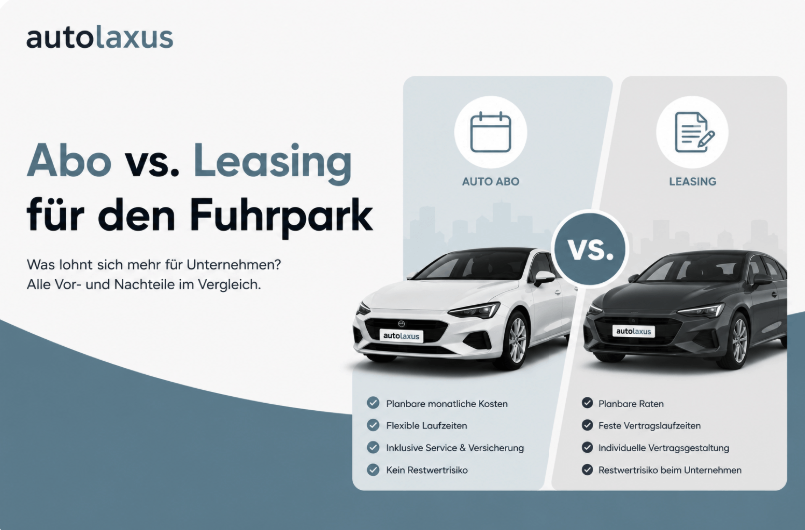
Car Subscription or Leasing —Which Option Best Fits Your Needs? Both models offer different advantages and differ in terms of flexibility, contract term, costs, and effort, among other factors.
In our comparison, we highlight the key differences and provide an overview of what matters when deciding between a car subscription and leasing. This makes it easy to quickly assess which model is best suited to your specific situation.
You can find the complete comparison here:
How well does a car subscription work in everyday professional life?
Jan Siebert from Autolaxus has explored exactly this question in practice. In his review, he shares his personal impressions and shows how the car subscription service performs in real-world use.
It’s not just about the usage itself, but also about the flexibility and the hassle-free process surrounding the car subscription.
Read Jan Siebert’s full experience report to find out what his conclusion is after the hands-on test:
More details about the study
The results show that interest in Chinese vehicle brands is growing in German fleets. At the same time, practical questions remain regarding service, spare parts supply, data protection, and residual values.
All the study’s findings in detail.
Mobility is a very personal matter: It determines how we get to work, how we reach our families, and how we organize our daily lives.
The new Ipsos Mobility Report 2026 shows that the car continues to play an important role for many people. At the same time, expectations regarding vehicles, powertrains, and mobility services are changing.
We took a look at the report that was released a few weeks ago, and five key findings stood out in particular.
1. The car remains firmly rooted in everyday life
According to the survey, 43 percent of drivers surveyed say they cannot imagine life without a car. Another 43 percent could, in principle, do without one, but would prefer to keep it. This is often driven less by an emotional attachment to a specific vehicle than by a desire for reliability and autonomy. Especially in a professional context, the car is increasingly seen as a practical tool for mobility. This is also confirmed by our latest trend analysis from June 2026: For 79 percent of respondents from companies with company cars, the mobility required for their daily work is the top priority.
2. Driving still offers a sense of freedom
For 33 percent of respondents worldwide, the car is the mode of transportation they enjoy the most. This puts it ahead of “walking,” which was cited by 22 percent. This enjoyment has a lot to do with personal freedom: being able to decide for oneself when to leave, which route to take, and where to stop along the way. At the same time, the report shows that people combine different modes of transportation depending on the route and situation.
3. Electric mobility requires positive experiences
47 percent of respondents worldwide find the idea of driving an electric car appealing. In Europe, however, there is still greater hesitation.
That’s why real-world experiences are key to acceptance: Does the range match my daily trips? Where can I charge the car? How does the vehicle perform in everyday use?
Here, too, the MHC Mobility Study offers an interesting comparison: When it comes to preferred future powertrain types for company vehicles, electric cars—at 46 percent—are already on par with gasoline-powered vehicles. So the willingness is there—companies and drivers need, above all, certainty regarding practical implementation.
4. New technology requires trust
Opinions on autonomous driving are divided. Globally, 36 percent of people would feel safe in a self-driving car, while another 36 percent would feel unsafe. In Europe, skepticism prevails. Technological progress is most convincing when it is understandable, safe, and transparent. Features alone do not build trust; trust is built through transparent communication and positive everyday experiences.
5. Mobility is a shared responsibility
55 percent of people are concerned about traffic safety in their neighborhoods. 70 percent support lower speed limits in residential areas, and 67 percent would like to see protected bike lanes. This shows that the car is increasingly viewed as part of a larger mobility system. Safe routes for pedestrians and cyclists, reliable public transportation, and vehicles for individual use complement one another.
“Mobility always starts with people’s everyday lives. This is especially true in the context of company cars. For some, a car is indispensable on a daily basis; for others, it’s just one mode of transportation among many. What matters most is that the options remain reliable, understandable, and flexible.”
“As a mobility provider, we must therefore listen carefully and create solutions that can adapt to changing needs,” says our CEO, Rainer Thies.
Mobility is becoming more diverse
The Ipsos Mobility Report does not paint a uniform picture of the future. That is precisely where its strength lies: mobility needs vary by region, occupation or industry, and personal circumstances. For companies, this means planning their fleets in a more nuanced way.
Which vehicle is right for the task? Which powertrain performs well in everyday use? How long will the vehicle be needed? And how much administrative work is involved? The future of mobility, therefore, depends less on any single technology. It depends on how well different solutions fit into people’s actual lives.
Germany only in midfield when it comes to the electrification of company fleets
The study published by the International Council on Clean Transportation (ICCT ) at the beginning of October 2025 on the decarbonization of company fleets in Europe underlines their central role in the European transport transition. Company vehicles account for around 60 percent of all new registrations in Europe. Due to their generally higher annual mileage and short average service life, they represent a particularly effective lever for the electrification of road transport.
However, Germany only occupies a middle position in the study. While the German government promotes BEVs and grants tax benefits, for example through accelerated depreciation regulations and reduced taxation of electric company cars, the incentives lag behind those of countries such as Belgium or the Netherlands. For example, companies in Belgium benefit from significantly more attractive tax breaks for electric vehicles, while vehicles with combustion engines are increasingly disadvantaged there in terms of taxation. As a result, Belgium is now one of the leading countries in Europe in terms of the proportion of electric company cars. The Netherlands, France, Sweden and Denmark also have above-average electrification rates in their company fleets – clear evidence of the direct impact of targeted policy measures.
Company cars lower entry barriers for private users too
The ICCT study emphasizes that the decarbonization of company car fleets is not only a key contribution to climate protection, but also boosts the market for electric mobility as a whole. Companies that opt for BEVs early on indirectly accelerate the availability of used vehicles and thus lower the barriers to entry for private users.
Overall, the study recommends coordinating national tax and subsidy programs more closely, introducing binding EU-wide target quotas for zero-emission company vehicles and consistently driving forward accompanying measures such as the expansion of the charging infrastructure. By taking such targeted steps, Germany could reduce its backlog compared to pioneering countries and at the same time make an important contribution to achieving the European climate targets.
The most important findings of the study at a glance:
- Company cars dominate the new car market: they make up the largest share of new registrations and are often driven significantly more than private vehicles, making a switch to electric models particularly effective for decarbonization.
- Germany in the middle of the pack: In a European comparison, Germany has so far been in the middle of the pack. Although there are tax incentives for battery electric vehicles (BEVs), for example through more favorable depreciation and reduced company car tax, these have not yet reached the level of pioneering countries such as Belgium.
- Binding targets work: Statutory quotas for zero-emission vehicles can significantly accelerate the electrification of fleets because they give companies clear planning security.
- Used market effect: As company cars enter the used car market after three to four years, private households can also gain early access to comparatively affordable electric vehicles.
- Political measures are crucial: In addition to tax incentives, a well-developed charging infrastructure, clear interim targets and accompanying support programs are necessary to efficiently implement the transformation of fleets.
Comprehensive advice on all aspects of your electric car fleet
When it comes to the decarbonization of company fleets, we at MHC Mobility see ourselves as a leading car subscription provider with a special responsibility: by designing our offers and providing intensive advice on vehicles and funding opportunities, we can accelerate the introduction of zero-emission vehicles and make the decision for electric vehicles more attractive for companies. We therefore have a direct influence on the composition of the fleet and can make a noticeable difference to the transport transition.
Would you like to know what benefits the electrification of your fleet will bring for your company? Feel free to contact us. We will advise you without obligation and find the optimum solution for you.
Analysis: These manufacturers are the winners of the IAA Mobility 2025
The new location of the IAA Mobility – on the Munich exhibition grounds and in the public space in the middle of the city – seems to have finally emancipated itself. This is the third time that the mobility trade fair has been held in the Bavarian capital, after many years in Frankfurt. And: the modernized IAA is back as a pacemaker in the global mobility discourse.
At the beginning of September, the IAA dominated the business and automotive media worldwide, as the latest study by the international provider of global media monitoring and social listening PRophet Media Intelligence shows, which took a close look at the public discourse surrounding the IAA Mobility.
One result: even before the start, some manufacturers provided initial impetus with exciting concepts – but the decisive boost came on the press day on September 8. Within three days, more content was created than in one month of the pre-show phase.
USA in 1st place in IAA reporting
First and foremost, the regional weighting of the reports and social media posts is surprising. Although electric leader Tesla has avoided the IAA this year and US manufacturers are underrepresented at the event, the
In contrast to the omnipresence of Chinese brands such as BYD, Dongfeng, Leapmotor or GAC in the Munich exhibition halls, the 14% mentions from China are far less significant than many expected, but are nevertheless clear evidence of the growing international resonance and the challenger role of Chinese OEMs.
In addition, the approximately 23% of all contributions from Asia-Pacific, South America and other regions once again underline the global mobility debate and the obviously well-done homework of the communication teams of manufacturers, but also of the trade fair itself.
German brands set the pace – also in public discourse
Despite the international nature of the media presence, the analysis shows an almost unexpected dominance of German manufacturers: VW, BMW and Mercedes-Benz secure the top positions in the Group ranking for the IAA – driven by premieres of new e-models such as the BMW iX 3 and strong concept presentations. Although the competitors from Asia are gaining weight, they only secure the lower places in the model ranking: Leapmotor Lafa 5 (6th place), Xpeng P7 (7th place) and Kia EV2 Concept (8th place).
Social media behind editorial reporting
The clear dominance of editorial online media over social media is also surprising. Although the mix during the trade fair days (compared to the pre-reporting phase) shifted significantly in favor of social media, for example on X, YouTube or Reddit, due to the easier content creation in the exhibition halls and at the freely accessible IAA Mobility Festival in downtown Munich, it still only accounted for just over a third of the discourse (36%). This dynamic is primarily driven by videos, reels and corporate posts from manufacturers. However, high-reach automotive media also continue to set the tone and ensure that product premieres such as electric SUVs and new e-models dominate the agenda.
Climate, e-mobility and high-tech topics dominate the agenda
However, IAA reporting is no longer just about product presentations. The balancing act between CO2/climate and the combustion engine has been one of the top 5 topics in the IAA context for a few years now and often appears in a neutral to critical context. The other relevant IAA topics: E-mobility, autonomous driving, digitalization & connected mobility are largely discussed positively as typical trade fair topics.
Despite the change in the law on special depreciation for electric company cars: why long-term rental is particularly worthwhile right now
Berlin – Companies that want to convert their vehicle fleets to electric cars will receive strong tax incentives from July 2025. As part of the tax investment offensive, the German government has decided to significantly improve the depreciation options for electric company cars used for business purposes. The aim is to promote investment, accelerate electromobility and provide tax relief for small and medium-sized companies.
Companies can now write off up to 75 percent of the acquisition costs for e-cars against tax in the first year. In addition, the special depreciation allowance of 40 percent will remain in place until at least 2028. At first glance, this sounds like a clear advantage for purchase models – but if you take a closer look, you will see that long-term rental remains a strong, often better alternative even under the new conditions.
While depreciation is spread over several years when a vehicle is purchased, the costs of a car subscription for commercially used vehicles continue to be fully deductible operating expenses with immediate effect – over the entire useful life of the vehicle. Companies thus benefit from clearly calculable costs without having to tie up capital or bear residual value risks. This is a decisive advantage, especially in economically difficult times.
What’s more, those who opt for long-term rental or leasing remain flexible. Terms, vehicle classes and services can be individually adapted to actual requirements – whether for short-term project vehicles, seasonal fluctuations or the gradual switch to electromobility. This makes these models particularly attractive for companies that want to manage their fleet strategically and remain agile at the same time.
Incidentally, the familiar rules continue to apply to the private use of company cars – such as the 1% rule or the reduced rate of 0.25% for electric vehicles under €60,000. These benefits apply regardless of whether the vehicle was purchased or rented.
The conclusion: If you want to invest in electromobility, you should do the math – but also ask questions. Buying an electric vehicle can make perfect fiscal sense if you have long-term planning and a high equity ratio. For everyone else, long-term rental is often the more pragmatic and plannable option – with high liquidity, clear monthly installments and full service.
MHC Mobility supports companies in precisely this decision-making process – from the selection of suitable e-vehicles to flexible long-term rental, including comprehensive services that relieve the burden on companies in terms of administration and fleet management. With sound advice, individual fleet solutions and a deep understanding of the needs of business customers, MHC Mobility is a strong partner for all those who want to benefit from the new framework conditions now.
The current status and the leading manufacturers at a glance
Autonomous or automated driving – or rather “being driven” – is considered one of the most exciting future technologies in the mobility sector. At the end of the 2010s, it was still being said in unison at the major motor shows: by 2025 at the latest, everything from the mid-range upwards will be driving almost by itself. But how far along is this technology really today? And who are the leading manufacturers? Let’s take a look at the status quo.
What does “autonomous driving” mean?
- Development is divided into five stages – from assistance systems to fully autonomous driving:
- Level 1: Driver assistance – e.g. adaptive cruise control or brake assistance.
- Level 2: Partial automation – the car can steer, brake and accelerate itself in certain situations. However, humans must constantly monitor it.
- Level 3: Conditional automation – in certain situations (e.g. on the highway), the driver may turn away from the traffic situation. The car drives autonomously, but the human driver must be able to intervene on demand.
- Level 4: High automation – the vehicle drives permanently autonomously in defined areas of use. A driver is optional.
- Level 5: Full automation – no driver required, the vehicle can drive anywhere independently.
Where do we stand today?
Currently, most of the systems available as standard are at level 2. Some models, such as those from Tesla, Mercedes-Benz and BMW, are approaching level 3.
In 2022, Mercedes-Benz was the first manufacturer worldwide to receive Level 3 approval in accordance with UN/ECE regulations – for its “Drive Pilot” system, initially in Germany. It allows autonomous driving up to 60 km/h on highways, for example in traffic jams. BMW also offers a similar system in the 7 Series.
Tesla relies heavily on software and camera data with its “Full Self-Driving” approach. The system is officially still level 2, but is constantly being expanded through regular over-the-air updates. However, critics criticize the misleading naming and call for stricter regulatory control.
Who is ahead internationally?
In the USA, tech companies such as Waymo (Alphabet/Google) and Cruise (General Motors) are developing autonomous robotaxi fleets, particularly in cities such as San Francisco and Phoenix. Some of these vehicles are already driving at level 4, albeit under clearly defined conditions (e.g. good weather, previously mapped area).
Apple, Amazon (with Zoox) and Baidu in China are also investing heavily in autonomous driving technologies. In China, robotaxis are already being tested in several major cities.
There is not yet a commercial robotaxi service in Germany. However, pilot projects are underway in several cities, such as Hamburg, Berlin and Munich, often as part of public transport and on fixed routes. The regulatory hurdles (road traffic regulations, liability, licensing) are high, but the Autonomous Driving Act of 2021 has created an initial legal framework for level 4 vehicles.
Challenges
Technically, autonomous driving is extremely complex: sensor technology (e.g. lidar, radar, cameras), real-time data processing, artificial intelligence and reliable communication with the infrastructure are required. There are also ethical, legal and insurance-related issues.
Science fiction is slowly becoming reality
Autonomous driving is no longer science fiction – but the road to the widespread introduction of Level 4 and 5 is still a long one. In the USA and China, robotaxi providers are pushing hard to enter the market. Mercedes-Benz and BMW are leading the way in Europe and are relying on a sensor mix of radar, LiDar and cameras, while Tesla is relying heavily on camera technology and scoring points with software innovation.
We are excited to see what the future holds and are already providing specific advice on all questions relating to (partially) automated driving.