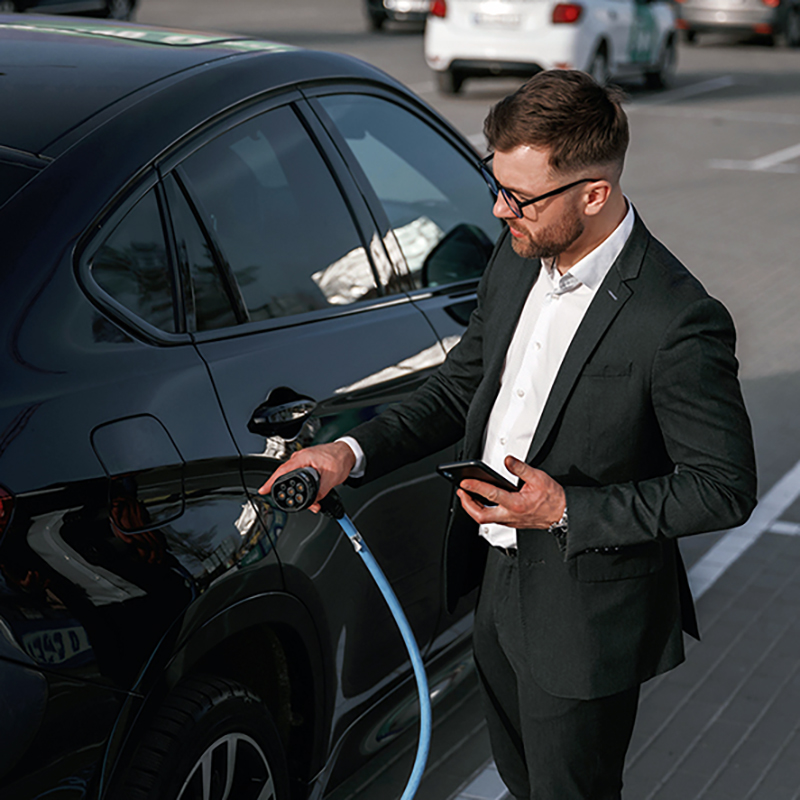
Electrify your fleet with MHC Mobility
Why fleet electrification is worthwhile for your company
Converting your fleet to electric is a decisive step towards a sustainable and economical future. An electric fleet is not only quiet and environmentally friendly, but also offers companies numerous advantages that go far beyond financial savings. For example, the benefits of fleet electromobility are directly reflected in your balance sheet and your corporate image.
- Healthier working environment: With no local exhaust fumes and a significantly lower noise level, your employees work with less stress and better air quality.
- Enormous image gain: An electric vehicle fleet, ideally charged with electricity from your own photovoltaic system, is completely emission-free. This strengthens your brand image as a modern and responsible company.
- Future security: With a fleet of electric vehicles, you can avoid the threat of driving bans for diesel in city centers. This ensures your unrestricted mobility and saves fleet management complex planning.
- Direct cost benefits: The savings don’t just start at the charging station. Lower maintenance costs, as electric motors do not require a gearbox, clutch or oil change, are noticeable from the very first inspection.
Converting your fleet to electric: a 5-step guide
Good planning and an overview of the technology and logistics are crucial to ensure that the electrification of your fleet runs smoothly. How to successfully integrate fleet electric vehicles into your fleet step by step.
Step 1: Analysis and advice – the basis for your e-car fleet
You are not alone on the road to an environmentally friendly electric vehicle fleet. The federal states offer individual consultations on economic efficiency, funding opportunities and all other topics relating to electromobility. Take advantage of this expertise to create a solid basis for decision-making.
Step 2: Needs analysis – Which electric vehicles are suitable for your fleet?
Concrete planning begins with an inventory of your current fleet. Take a look at the logbooks and analyze them:
- Route profiles: Are the routes primarily short or long distances?
- Standing times and locations: Where are the vehicles parked and for how long? This is where the potential for charging points lies.
- Transport load: Are heavy goods being transported that affect the range?
- Capacity utilization: Is there excess capacity that would allow a reduction in fleet size?
These findings form the basis for the selection of suitable vehicle models and the planning of the charging infrastructure.
Step 3: Selecting the right e-vehicles for your commercial fleet
The market for electric cars for commercial use is growing rapidly. Manufacturers are offering an ever greater variety of models with increasing ranges and performance. Based on your analysis, you can now select the right vehicles:
- Commercial vehicles: For the transportation of goods and tools, models such as the Opel Combo-e Cargo XL 50 kWh
- Passenger car: For journeys without heavy freight, electric cars are the cheaper choice. Depending on space requirements, models such as the Fiat 500 e 42 kWh or the Volkswagen ID.3 77 kWh are possible.
Our recommendation: Start converting your fleet to electric gradually. This will allow you to gain initial experience and fleet management can react flexibly to the need for optimization. Discover our e-car subscription.
Step 4: Plan the charging infrastructure – the heart of your electric vehicle fleet
A well thought-out charging infrastructure ensures that your electric vehicle fleet is always ready for use. The key question is: How many vehicles need to charge at the same time?
- Central charging stations at the vehicle fleet: Plan sufficient space for charging stations (wall boxes or fast chargers) near power connections. Think long-term and reserve space for future expansions. Intelligent time management can reduce the number of charging points required.
- Decentralized charging (wallboxes at home): Employees can conveniently charge their company cars at home overnight. This relieves the strain on the infrastructure at the company site. The billing of electricity costs can be regulated in an uncomplicated manner.
- Mobile charging systems: Mobile chargers are ideal for an initial test with a few e-vehicles, as they often only require an existing power connection (CEE socket) and avoid high investments.
Step 5: Optimization and expansion – perfecting the eco-balance
The Electrification of your fleet is the first step. You can exploit the full potential with these measures:
- Own solar power: Combine your electric vehicle fleet with a photovoltaic system. This means that your vehicles are completely emission-free, you save on operating costs and become independent of electricity providers.
- Public charging points: Make your charging stations publicly accessible (in compliance with the Charging Station Ordinance). This generates additional income, shortens the amortization period and acts as excellent advertising for your environmentally friendly company.
- Alternative mobility incentives: Encourage people to travel by bike, car sharing or car pooling. This relieves the strain on your charging infrastructure and strengthens the sense of community.
Conclusion: When is it worth switching to an electric fleet?
Opting for an electric car fleet is the trend and for good reasons. Converting the fleet to electric cars pays off both ecologically and financially. The e-car fleet unfolds its full potential if the routes can be planned and the charging infrastructure is intelligently coordinated with the vehicles’ downtimes. Instead of investing heavily in vehicle purchases, flexible planning with an e-car subscription from providers such as MHC Mobility allows a risk-free test and a gradual changeover. This makes fleet electrification one of the best and safest investments in the future of your company.
Do you still have questions?
Let MHC Mobility advise you.