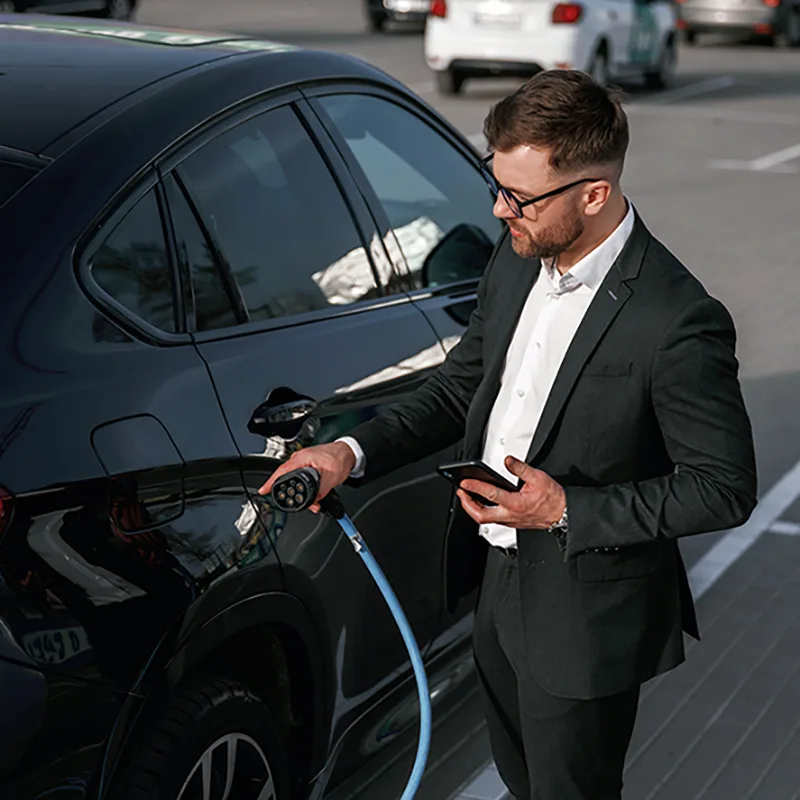
Electrify Your Fleet with MHC Mobility: Building an Electric Fleet for Businesses
Why fleet electrification is worthwhile for your company
Converting your fleet to electric is a decisive step towards a sustainable and economical future. An electric fleet is not only quiet and environmentally friendly, but also offers companies numerous advantages that go far beyond financial savings. For example, the benefits of fleet electromobility are directly reflected in your balance sheet and your corporate image.
- A healthier work environment: With no local exhaust fumes and significantly lower noise levels, your employees can work with less stress and enjoy better air quality.
- Enormous image gain: An electric vehicle fleet, ideally charged with electricity from your own photovoltaic system, is completely emission-free. This strengthens your brand image as a modern and responsible company.
- Future security: With a fleet of electric vehicles, you can avoid the threat of driving bans for diesel in city centers. This ensures your unrestricted mobility and saves fleet management complex planning.
- Direct cost benefits: The savings don’t just start at the charging station. Lower maintenance costs, as electric motors do not require a gearbox, clutch or oil change, are noticeable from the very first inspection.
Converting your fleet to electric: a 5-step guide
Good planning and an overview of the technology and logistics are crucial to ensure that the electrification of your fleet runs smoothly. How to successfully integrate fleet electric vehicles into your fleet step by step.
Step 1: Analysis and advice – the basis for your e-car fleet
You are not alone on the road to an environmentally friendly electric vehicle fleet. The federal states offer individual consultations on economic efficiency, funding opportunities and all other topics relating to electromobility. Take advantage of this expertise to create a solid basis for decision-making.
In addition, MHC Mobility supports the transition process with its own fleet services: Fleet analysis for structured needs assessment, Fleet management for ongoing management, and One-stop mobility solutions for bundling vehicle and service packages. This allows consulting on fleet electrification to be directly integrated with operational tools.
Step 2: Needs analysis – Which electric vehicles are suitable for your fleet?
Concrete planning begins with an inventory of your current fleet. Take a look at the logbooks and analyze them:
- Route profiles: Are the routes primarily short or long distances?
- Standing times and locations: Where are the vehicles parked and for how long? This is where the potential for charging points lies.
- Transport load: Are heavy goods being transported that affect the range?
- Capacity utilization: Is there excess capacity that would allow a reduction in fleet size?
These findings form the basis for selecting the right vehicle models and planning the charging infrastructure. For a reliable estimate of range and energy consumption, please refer to the page on electric vehicle range and charging times.
Step 3: Selecting the right e-vehicles for your commercial fleet
The market for electric cars for commercial use is growing rapidly. Manufacturers are offering an ever greater variety of models with increasing ranges and performance. Based on your analysis, you can now select the right vehicles:
- Commercial vehicles: Models such as the Opel Combo-e Cargo XL 50 kWh and, as a complementary option, the Opel Vivaro-e for larger transport needs, and the Mercedes E-Sprinter for the electric large-capacity variant.
- Passenger car: For journeys without heavy freight, electric cars are the cheaper choice. Depending on space requirements, models such as the Fiat 500e 42 kWh or the Volkswagen ID.3 77 kWh in question. For longer distances and formal occasions, there are also Tesla Model 3 and Tesla Model Y each offering over 600 kilometers of WLTP range, compact city cars such as the Hyundai Kona EV and electric SUVs such as the Audi Q4 Sportback.
Our recommendation: Start converting your fleet to electric gradually. This will allow you to gain initial experience and fleet management can react flexibly to the need for optimization. With FlexiRent, individual electric vehicles can be added to your fleet on a trial basis for a minimum of one month. For long-term integration with a custom-configured new vehicle of your choice, consider SelectRent or the long-term electric vehicle lease.
Step 4: Plan the charging infrastructure – the heart of your electric vehicle fleet
A well thought-out charging infrastructure ensures that your electric vehicle fleet is always ready for use. The key question is: How many vehicles need to charge at the same time?
- Central charging stations at the vehicle fleet: Make sure to leave enough space for charging stations (wall boxes or fast chargers) near electrical outlets. Think long-term and leave room for future expansion. Smart time management can reduce the number of charging points needed.
- Decentralized charging (wallboxes at home): Employees can conveniently charge their company cars at home overnight. This reduces the strain on the infrastructure at the company’s location. Billing for electricity costs can be handled easily.
- Mobile charging systems: Mobile chargers are ideal for an initial test with a few e-vehicles, as they often only require an existing power connection (CEE socket) and avoid high investments.
Wallbox Partner LichtBlick: For the charging infrastructure, MHC Mobility is partnering with LichtBlick as a partner for e-mobility, wall boxes, and green electricity. Through this partnership, charging solutions and electricity rates can be directly linked to the electric vehicle subscription. Plug-and-charge-enabled wallboxes simplify automatic billing in accordance with ISO 15118 and reduce the administrative burden on the accounting department.
Step 5: Optimization and expansion – perfecting the eco-balance
The Electrification of your fleet is the first step. You can exploit the full potential with these measures:
- Own solar power: Combine your electric vehicle fleet with a photovoltaic system. This means that your vehicles are completely emission-free, you save on operating costs and become independent of electricity providers.
- Public charging points: Make your charging stations publicly accessible (in compliance with the Charging Station Ordinance). This generates additional income, shortens the amortization period and acts as excellent advertising for your environmentally friendly company.
- Alternative mobility incentives: Encourage people to travel by bike, car sharing or car pooling. This relieves the strain on your charging infrastructure and strengthens the sense of community.
Incentives for Your Business: Smart Ways to Cut Electric Vehicle Costs
Many companies are reluctant to invest because they are concerned about the initial costs. But this is exactly where the government steps in. For an electric car in the Commercial There are attractive incentive programs that significantly reduce the purchase cost. Incentives for commercial electric vehicles include:
- Tax incentives: Take advantage of tax benefits when purchasing and operating electric vehicles. For private use as company cars, fully electric vehicles are taxed at only 0.25 percent of the gross list price, provided the gross list price does not exceed 100,000 euros (effective July 1, 2025, Section 6(1)(4) of the Income Tax Act). In addition, they are exempt from motor vehicle tax until the end of 2030, provided that the initial registration took place by December 31, 2025.
- Regional incentive programs: Depending on the company’s location, additional incentives are available to help ease the financial burden of the transition.
- GHG quota: As an operator of charging stations or an electric vehicle fleet, you can generate additional revenue.
The combination of these benefits ensures that government incentives for commercial electric vehicles have an immediate positive impact on your bottom line.
Conclusion: When is it worth switching to an electric fleet?
Opting for an electric car fleet is the trend and for good reasons. Converting the fleet to electric cars pays off both ecologically and financially. The e-car fleet unfolds its full potential if the routes can be planned and the charging infrastructure is intelligently coordinated with the vehicles’ downtimes. Instead of investing heavily in vehicle purchases, flexible planning with an e-car subscription from providers such as MHC Mobility allows a risk-free test and a gradual changeover. This makes fleet electrification one of the best and safest investments in the future of your company.
Do you have any questions about fleet electrification?
Give us your contact details and we will get back to you.
Thank you very much!
We have received your information and will contact you shortly.
FAQ: Frequently Asked Questions About Fleet Electrification
The transition of the fleet to electric vehicles will take place in five steps: First, an analysis of the current fleet (routes, downtime, utilization). Second, demand planning for vehicles and charging points. Third, the selection of specific electric vehicles that match the profile. Fourth, the establishment of the charging infrastructure, combining central charging stations with decentralized home charging. Fifth, optimization through solar power, public charging stations, and alternative mobility options. An electric car subscription is particularly well-suited for the first two phases, as individual vehicles can be integrated on a trial basis for a minimum of one month.
The costs consist of three components: vehicles, charging infrastructure, and ongoing operations. When purchasing electric vehicles, a significant amount of capital is tied up initially; with leasing, this is not the case, though a down payment is usually required. With MHC Mobility’s car subscription, the monthly payment is the only ongoing obligation besides electricity and fuel, with no down payment required. The charging infrastructure ranges from simple wall boxes (around 1,000 to 2,500 euros per point) to DC fast chargers (significantly higher). Parts of the investment can be recouped through regional incentive programs and the GHG quota.
The switch is particularly worthwhile if driving routes can be planned in advance and the vehicles have sufficient downtime at the charging station. If routes vary widely or if there are frequent long-distance trips without predictable charging windows, the transition is more challenging. If you’re unsure, you can start with one or a few vehicles through MHC Mobility’s electric car subscription service, observe how it works in practice, and expand gradually without committing to a long-term contract.
The environmental bonus for electric vehicle purchases expired at the end of 2023. Currently, companies have three options available: first, the 0.25% rule for private use of company cars that are purely electric vehicles with a gross list price of up to 100,000 euros (effective as of July 1, 2025); second, the vehicle tax exemption through the end of 2030 for electric vehicles first registered by December 31, 2025; and third, regional programs for wallbox installations through municipal utilities, state ministries, and local economic development agencies. In addition, revenues from the GHG quota generate additional income.
The choice depends on the intended use. For city and commuter routes, compact models such as Fiat 500e or Hyundai Kona EV. The following are suitable for the mid-range category with a longer range VW ID.3, Tesla Model 3 and Audi Q4 Sportback. For the transportation sector, there are Opel Combo-e, Opel Vivaro-e and the Mercedes E-Sprinter are ready.
Smart charging management distributes the available power across multiple vehicles, prioritizing based on the next day’s trips and avoiding peak loads. Plug-and-charge-enabled wallboxes (in accordance with ISO 15118) enable automatic authentication and billing via the charging cable, without a charging card or app. At the site, 11-kW wallboxes are the standard; DC fast chargers are used for quick in-between charging. For detailed information on charging methods and charging times, please visit the page on Electric Car Range and Charging Time.
The duration depends on the size of the fleet and its current status. Smaller fleets of five to ten vehicles can be converted within six to twelve months, while larger fleets typically require 18 to 36 months. Often, it is not the vehicles themselves but the charging infrastructure and connection permits that determine the timeline. A phased transition using short-term car subscription contracts reduces complexity because individual vehicles can be introduced independently of one another.
With traditional leasing, the company commits to a fixed term of 36 to 60 months and bears the residual value risk. Maintenance, insurance, tire service, and vehicle tax are billed separately. With MHC Mobility’s car subscription, all these items are included in a monthly flat rate; there is no down payment, and the minimum term is one month. For gradual electrification with a real-world test, the car subscription is the more flexible option. For long-term, stable fleets with custom-configured new vehicles, SelectRent or a long-term lease may be a better fit.