When craft businesses talk about mobility
Hallo Handwerk: We asked once.
When trade businesses talk about mobility, they rarely do so in “would have, ifs and buts…”.
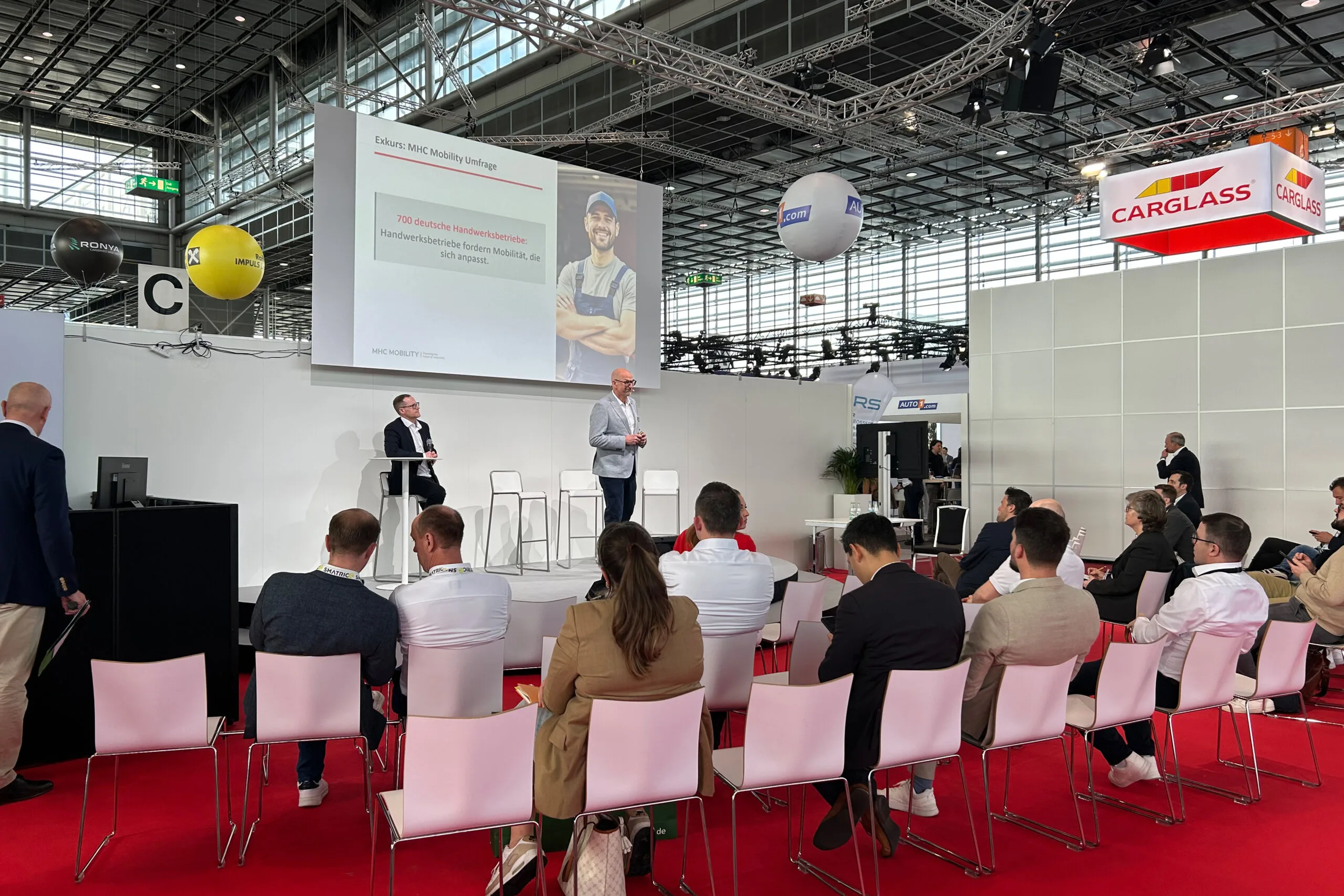
A vehicle must work. Period. And it must be suitable for everyday work: calculable, quickly available and flexible to use. This is exactly what our representative survey of 700 German trade businesses confirms.
For us at MHC Mobility, these results are more than just “exciting figures” – they are like a confirmation of our daily work and a pretty clear mission for the future.
Predictable costs: our lever is transparency
54% of companies cite favorable conditions and predictable total costs as decisive. Good for us: our prices and services are already so clear that they can be calculated immediately in the company – without a maze of footnotes.
Fast availability and simple processing: speed is part of the service
46% want fast availability and simple processing.
This is not a “nice to have”, it is an operational reality. When a major order comes in or a vehicle breaks down, speed determines productivity. To keep things running smoothly, we keep our processes particularly simple and ensure vehicle replacement or fleet replenishment at the speed of light.
Flexible terms and car subscription: mobility without stomach ache
38 % of the skilled trade companies surveyed want flexible contract terms, such as monthly termination. This is a direct fit with what we stand for: Mobility that doesn’t get stuck when the order situation, personnel or projects change.
What does that mean for us in concrete terms? Continue to think of car subscriptions and flexible models as a toolbox: ramp up in the short term, ramp down when needed – without drama.
Service and personal contact: Relief is a product
39 % expect the following for their fleet Complete services incl. maintenance, insurance, tire service etc. One third would like a personal contact person.
This is a clear signal: many companies don’t want to “co-manage” mobility, they want to hand it over – to someone who can do it and has their back.
Our full-service approach is therefore not a “nice to have”, but a genuine core benefit. Personal support remains a central element – because good solutions are rarely standard in the trade.
Looking ahead: profitability and change go hand in hand
34%, or around a third of the companies surveyed, mentioned a switch to electric/alternative drives. Although this is not yet priority 1, it is a solid basis and a clear sign that undogmatic advice is also required here. For most companies, decarbonizing the fleet is less about “image” and more about reliability (e.g. range in winter, charging times, monthly costs).
We will therefore continue to integrate solutions in such a way that companies can sustain them on a day-to-day basis, not just on paper. The survey clearly shows that flexibility remains an obligation, but it is increasingly becoming part of a system of reliability, transparency and cost certainty – especially for larger companies.
Or to put it in technical terms: mobility has to work – not run. And that is exactly what we will continue to be there for in the future.